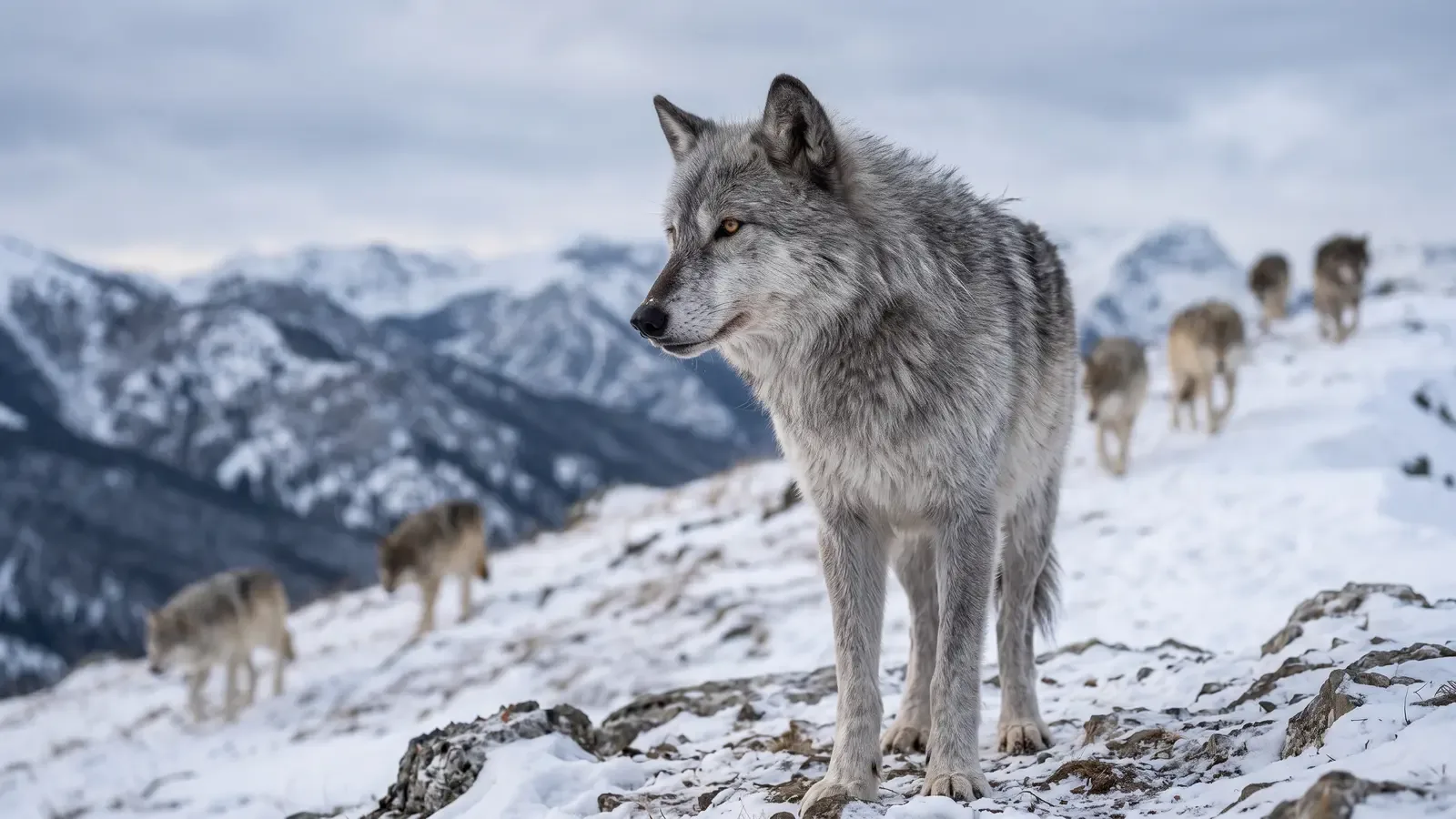
Wolf symbolism tends to circle three core themes that people return to again and again: loyalty to the pack, independence on the edge of it, and instinct that can feel older than words. The wolf is one of those animals that holds tension well. It can represent belonging without losing the self, and solitude without collapsing into isolation.
This article approaches wolf symbolism as contextual animal symbolism: a way to reflect on your own patterns using an animal’s observed behavior, plus a look at how wolves have been imagined in specific cultural and literary settings. It isn’t a “one true meaning” dictionary, and it doesn’t flatten diverse Indigenous traditions into a single pan-meaning. If you’re exploring spirit-animal language, it also helps to get clear on terms and cultural specificity first: What Is a Spirit Animal? Meanings and Cultural Context
Why the wolf carries so much symbolic weight
Wolves live close to human imagination because they live close to human structures. They hunt cooperatively, raise young communally, communicate through voice and posture, and hold territory. In symbolic use, that combination becomes a mirror for questions like:
Who do I belong to, and what do I owe them?
Where do I need to stand apart to stay true to myself?
What do I know in my body that I keep talking myself out of?
The wolf is also a symbol shaped by fear, admiration, and misunderstanding. For centuries in parts of Europe, wolves were framed as threats to livelihood and safety. In modern media, wolves are often romanticized as pure wildness, or simplified into dominance myths. Symbolically, that mixed reputation is part of the point: wolves invite you to notice where your story about “wildness” is coming from.
The heart of wolf symbolism: loyalty, independence, instinct
Loyalty: the pack as chosen commitment
In modern symbolic usage, wolf loyalty isn’t sentimental. It’s practical, embodied, and earned through participation. A wolf doesn’t prove loyalty by agreeing with everything; it proves loyalty by showing up in the shared work of survival.
As a reflection prompt, wolf loyalty can illuminate the difference between:
Belonging and blending
Support and self-erasure
Accountability and control
Concrete example: you might feel “wolf energy” when you’re the person who checks on a friend in crisis, not because you’re rescuing them, but because your ethics are communal. Or when you realize you’ve been loyal to a job, a family role, or a social group long after the relationship stopped being mutual.
Wolf symbolism can be a gentle but firm question: where is your loyalty alive, and where is it simply familiar?
Independence: the boundary that keeps love honest
Wolves are social, but not always together. Individuals range, scout, disperse, and sometimes live on the margins. Symbolically, the wolf often appears when a person is renegotiating autonomy.
Independence here isn’t the solitary “I need no one” pose. It’s the ability to maintain selfhood inside relationship.
Concrete example: you may love your community and still need to change how reachable you are. You may be devoted to a partnership and still need solitude to think. Wolf symbolism supports the idea that distance can be part of care, not a failure of it.
If the wolf shows up repeatedly in your attention, consider whether you’re being asked to clarify a boundary, not burn a bridge.
Instinct: knowing before you can explain
“Instinct” is a tricky word because it’s easy to confuse with impulse, anxiety, or old conditioning. In modern spiritual and self-reflection language, wolf instinct usually points to body-knowing: pattern recognition, sensory intelligence, and the signal that arrives before the story.
This is where it helps to slow down and differentiate. If you’re prone to spiraling, a strong “gut feeling” can be anxiety dressed up as certainty. If you’re prone to overthinking, real intuition may feel quiet and almost disappointingly simple. For a deeper comparison, see Intuition vs. Anxiety: Understanding the Difference
A wolf-symbol reflection question is: what do I keep sensing that I keep arguing with?
Wolf meanings in culture: a few specific lenses (not universal claims)
Wolves don’t mean one thing across all cultures. Even within one region, the symbolic wolf can be protector in one story and villain in another.
European folktales: the wolf as appetite and danger
In parts of European folklore, the wolf frequently plays the role of the dangerous outsider: hunger, predation, temptation, the thing that waits beyond the village light. Stories like Little Red Riding Hood (in its many versions) and The Three Little Pigs helped fix a particular symbolic wolf in popular imagination: cunning, threatening, and hard to reason with.
If this is the wolf you carry, the symbol may arise when you’re working with fear of the unknown, distrust, or vigilance. It can also point to a shadow theme: appetite. Not only sexual appetite (though some retellings lean that way), but appetite for power, attention, or control.
Used carefully, this wolf invites honesty: what am I hungry for, and what happens when I pretend I’m not?
Roman myth: the she-wolf as fierce nourishment
A very different symbolic wolf appears in Roman foundation mythology, where the she-wolf nurses Romulus and Remus. Here the wolf is not the enemy at the gate but a figure of fierce, almost impossible caretaking: life arriving from the wild when human institutions fail.
In modern symbolic reading, this can connect to themes of unconventional support: being helped by an unexpected source, or discovering that your own “wild” qualities are not a problem to be civilized away, but part of how you endure.
Modern nature writing and ecology: the wolf as relationship in an ecosystem
Contemporary wolf symbolism is also shaped by ecology and conservation: wolves as keystone predators, as contested neighbors, as animals whose presence changes how landscapes behave.
Even without making sweeping claims, this lens can deepen the symbol. The wolf becomes a reminder that your life is not only personal; it’s relational. Your choices affect the “herd” you move with, the people who feel safe around you, and the patterns you normalize.
Symbolically: what changes when you return to your rightful place in the system—neither over-responsible nor absent?
For a wider comparative approach to animal symbolism (and how meanings vary), see Animal Symbols Across Spiritual and Cultural Traditions
The wolf’s shadow side: what the symbol may be warning against
Every rich symbol has a shadow. Wolf symbolism isn’t only about noble loyalty or clean instincts. It can also reveal where those qualities get distorted.
Loyalty becomes complicity. Staying “with the pack” can mean tolerating disrespect, enabling harm, or keeping secrets that corrode your integrity.
Independence becomes isolation. If you’ve been disappointed too often, “I’m a lone wolf” can become a shield that blocks closeness.
Instinct becomes reactivity. When you’re activated, you might interpret every discomfort as a sign to flee or attack.
A useful test is time. True instinct usually holds steady when you calm down. Reactivity usually escalates with more thinking.
When wolf symbolism shows up in your life
People tend to search wolf symbolism when the wolf arrives in one of four ways: through imagery you keep noticing, through dreams, through repeated themes in media or art, or through a felt identification that comes out of nowhere.
Rather than treating that as a cosmic assignment, treat it as a prompt. Not “What is the universe telling me?” but “What part of me is becoming audible?”
Here are a few grounded contexts where wolf symbolism often fits.
You’re renegotiating belonging
Maybe you’re changing friend groups, leaving a workplace culture, or realizing your family role has been holding you in place. The wolf can symbolize the grief and relief of shifting allegiance.
Reflection prompt: which connections make you braver, and which connections make you smaller?
You’re leading, mentoring, or parenting
Wolves are often symbolized as teachers of cooperative strength, not solo heroism. If you’re responsible for others, the wolf can bring questions about guidance versus control.
Reflection prompt: am I modeling trust and skill-building, or am I trying to manage outcomes?
You’re learning to trust yourself again
If you’ve ignored your own signals for a long time—because of pressure, performance, or people-pleasing—wolf instinct symbolism can show up as a re-wilding of self-trust.
Reflection prompt: what did I know early on that I only admitted later?
If you want a broader framework for “inner guidance” language without turning it into certainty, see What Does It Mean to Trust Your Inner Guidance?
Wolf symbolism in dreams: don’t turn it into a prediction
Dream wolves can be startling: chasing wolves, friendly wolves, wounded wolves, a pack, a lone wolf, a wolf at your door. It’s tempting to look up a fixed meaning and call it solved.
A more useful approach is to anchor the dream in three realities:
Your emotional tone in the dream (fear, awe, companionship, curiosity)
The wolf’s behavior (watching, leading, attacking, playing, guarding)
Your current life situation (conflict, decision, relationship boundary)
A wolf that watches from a distance can feel like your own caution: the part of you that doesn’t trust the room yet. A wolf that leads can feel like competence emerging. A wolf that attacks may reflect pressure, threat, or your own anger demanding attention.
For a dream-focused approach that holds uncertainty rather than pretending to be a dictionary, see What Does It Mean When You Dream About an Animal?
How to work with wolf symbolism without flattening culture
Wolf symbolism is powerful, and that power can make people careless—especially online, where “spirit animal” gets used as an aesthetic rather than a relationship or responsibility.
A respectful practice is simple: be specific about what you mean and where your meaning comes from.
If you’re using the wolf as a personal metaphor, you can say so plainly: “The wolf represents loyalty and boundaries for me right now.” That’s honest and doesn’t claim to speak for anyone else.
If you’re drawing from a named tradition, name it accurately, and learn from appropriate sources. Avoid generic statements like “In Native culture, the wolf means…” because there is no single “Native culture,” and many practices are not meant for outsiders to borrow.
For practical guidance on attribution, language, and boundaries, see How to Explore Animal Symbolism Without Cultural Appropriation
A simple wolf reflection practice: pack, path, and pulse
If the wolf is on your mind, try this three-part reflection. It’s designed to be useful without requiring you to adopt any spiritual label.
Pack: write down the names of the people, places, and commitments you consider “yours.” Then circle the ones that feel mutual. Put a question mark by the ones that rely on you shrinking.
Path: describe, in one paragraph, the most independent decision you’re avoiding. What would it cost socially? What would it save internally?
Pulse: choose one situation you’re overthinking. Describe what your body does when you imagine saying yes, and what your body does when you imagine saying no. Don’t argue with it yet. Just record the signal.
You’re not looking for a perfect answer; you’re learning your own language of loyalty, independence, and instinct.
If you want a guided way to explore it
If you like the spirit-animal frame and want a gentle introduction to how it’s commonly used in modern self-reflection (without treating it as a commercial quiz destiny), start here: About Spirit Animal Sketch & Reading
Wolf symbolism, at its best, doesn’t make you more performative about being “wild.” It makes you more honest about what you’re devoted to, what you need space from, and what you already know—before you have the courage to say it out loud.
Sources & further reading
Sources provide context for the specific topics discussed. They do not establish supernatural claims or endorse the reading experiences.