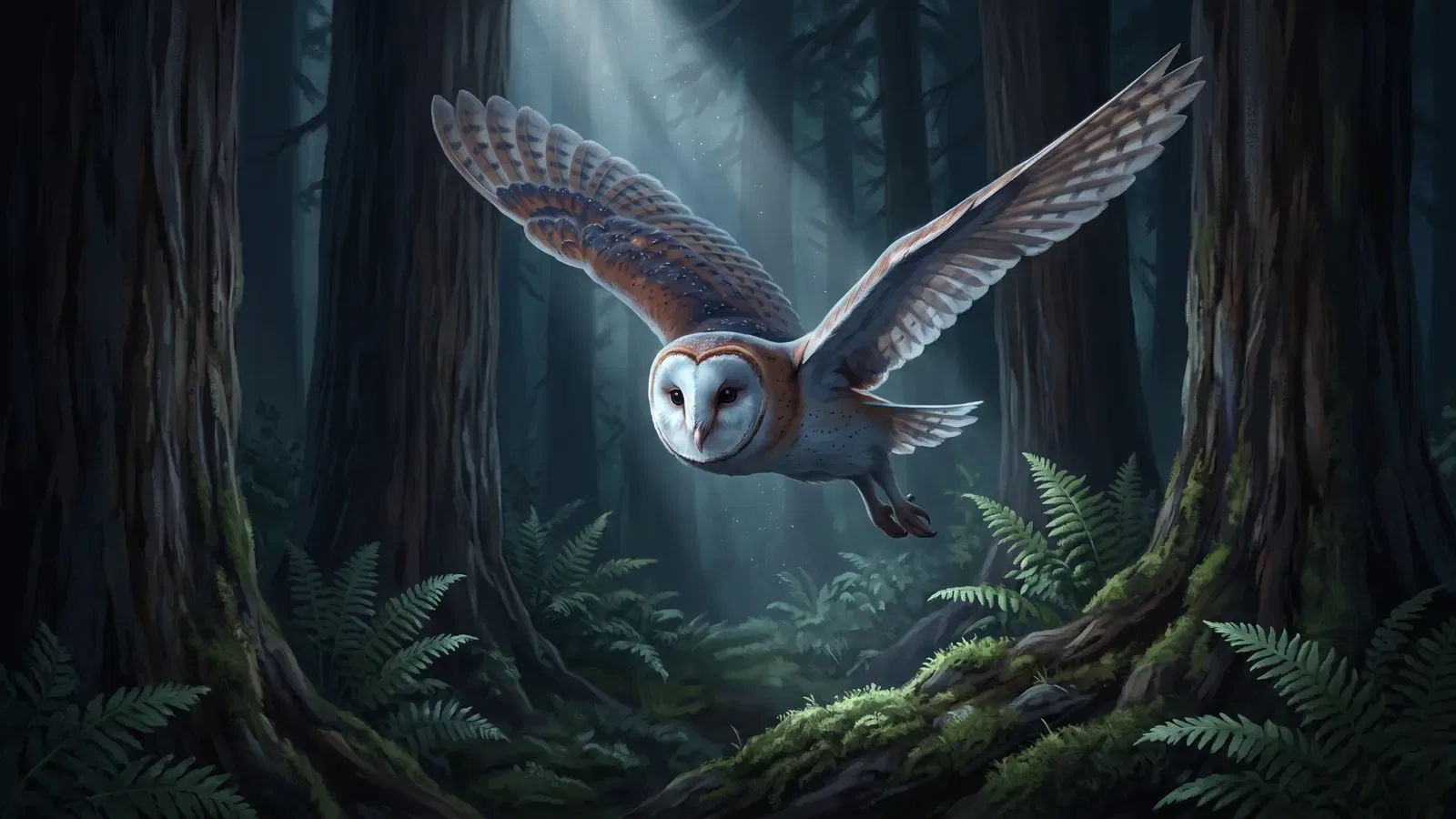
Owl symbolism often gathers around two broad themes: wisdom and observation. At the same time, owls can also be linked with warning, boundary-crossing, or the uncanny in some traditions. Rather than having one fixed “meaning,” the owl frequently reflects how a given culture imagines night, knowledge, and what is difficult to perceive.
If you’re here because an owl has shown up in your life—on a walk at dusk, calling outside your window, or recurring in stories or dreams—a comparative approach is usually most helpful. You can hold more than one meaning at once and ask what kind of wisdom is being emphasized: study and strategy, intuition and vigilance, or a sober recognition that not everything is knowable on demand.
Why owls become symbols so easily
Owls are associated with the edges of visibility. Many species are active at night or twilight, and their quiet flight, keen hearing, and forward-facing gaze can feel striking to human observers. These traits invite symbolic interpretation.
In practical terms, people often reach for owl symbolism during periods of incomplete information. The symbol can function as a reminder to slow down, listen more carefully, and notice what changes when others stop paying attention. This is spiritual or psychological meaning-making, not a medical assessment or an objective measure of personality.
Ancient Greece: Athena’s owl and the prestige of clear-eyed intelligence
A well-known association comes from classical Greece, where the owl is linked with Athena (Minerva in Roman tradition). The “owl of Athena” appears in ancient art and coinage and becomes a visual shorthand for a kind of intelligence that is disciplined and applied—knowledge in service of craft, civic life, and strategy.
Read as a reflective lens, this tradition frames wisdom less as prophecy and more as discernment: seeing what’s relevant, selecting what matters, and acting with steadiness.
Questions that fit this symbolic stream include:
What information am I ignoring because it’s inconvenient?
Where do I need preparation and skill more than a leap of faith?
What would it look like to make a calm plan instead of an anxious guess?
This approach treats the owl as a prompt for reflection, not a prediction device.
Rome and later European folklore: the owl as omen and uneasy messenger
As symbols travel, they can pick up darker associations. In parts of Roman and later European folklore, owls sometimes appear as ill-omened or unsettling figures, reflecting longstanding human anxieties about night, uncertainty, and loss of control.
Some classical and later literary sources link owls with lament or ill fortune, and in some medieval and early modern European contexts, nocturnal birds could be drawn into broader fears around witchcraft or disturbance of the natural order. These associations vary by time and place and shouldn’t be treated as a single uniform “European meaning.”
Handled carefully, “omen” language can be used as a psychological check-in rather than a literal forecast.
A grounded way to work with this symbolism is to ask:
What am I afraid to look at directly?
Am I treating uncertainty as danger?
What would help me distinguish intuition from anxiety?
Hindu traditions: the owl and Lakshmi in some lineages
In some Hindu traditions, the owl is associated with Lakshmi, a major goddess linked with prosperity and auspiciousness. As with many religious symbols, emphasis and interpretation can differ across regions and communities, and it’s best to treat this as one stream of meaning rather than a universal rule.
Read symbolically, an owl in this context can invite reflection on discernment and stewardship: not just what arrives, but how one relates to resources, values, and responsibility.
Prompts that align with this ethical framing include:
What am I calling “abundance,” and does it genuinely nourish my life?
Where do I need better stewardship of time, energy, attention, or finances?
What is the next wise step, not the most dramatic one?
This kind of symbolism is not a guarantee of wealth or outcomes. It is a way of organizing attention and values.
Japan: owls, “fukurō,” and popular good-fortune motifs
In Japan, owls appear in crafts and modern talismans often associated with good fortune or protection. Some popular explanations draw on wordplay around “fukurō,” including folk-style interpretations sometimes glossed as “no hardship.” These readings are commonly presented as playful or symbolic rather than as a single authoritative linguistic or religious doctrine.
Approached respectfully, this strand of symbolism pairs well with practical steadiness: habits that support safety, good judgment, and consistent study rather than grand promises.
The Americas: diverse meanings rather than a single “Indigenous view”
Across the Americas, owl symbolism varies widely among Native nations and local communities. In some contexts owls may be viewed as protective; in others, owl calls may be treated as warnings; elsewhere, owls may appear in specific stories or ceremonial frameworks with guidelines about what can be shared.
The most respectful approach is specificity: identify the nation, language group, and context, and recognize that some knowledge is not meant to be generalized or adopted casually. Broad claims like “Native Americans believe X” tend to flatten living traditions.
What “wisdom” means in owl symbolism (and what it doesn’t)
“Wisdom” can sound flattering, but in owl symbolism it is often demanding. It points to observation without rushing to certainty.
Wisdom as patience
Owls wait. Symbolically, this can suggest allowing a situation to reveal itself with time—not passive avoidance, but considered timing.
Wisdom as selective attention
Observation isn’t the same as watching everything. Owl symbolism can suggest tracking a few meaningful signals consistently: a pattern in spending, a recurring conflict dynamic, or the body’s response to a particular obligation.
Wisdom as comfort with partial darkness
Owls move effectively without noon-day clarity. Symbolically, this can validate seasons when you can’t name the whole story yet, but can still take the next honest step.
These are spiritual and psychological interpretations, not diagnostics and not evidence of fixed personality traits.
When an owl appears: three grounded ways to work with the symbol
You don’t have to decide whether an owl is an objective “sign” to find meaning in an encounter. You can treat it as a prompt for reflection.
Name the setting, not just the animal
Where did you see or hear the owl? What was happening in your life at the time? Context often shapes meaning.
Choose a tradition of meaning, then test it gently
If you resonate with Athena, focus on study and strategy. If you resonate with Lakshmi in a Hindu devotional or symbolic frame, focus on values and stewardship. If you resonate with modern good-fortune motifs, focus on small protective routines.
Then test your interpretation with one concrete action: read one chapter, make one plan, have one clarifying conversation, or reduce one avoidable risk.
Watch for projection
Symbols can amplify what you already feel. Anxiety can turn an owl into an omen; a craving for certainty can turn it into a fortune cookie. The practice is noticing those impulses and returning to observation.
Owl dreams: observation, secrecy, and what you might be avoiding
Owls in dreams are often interpreted as images of what feels hidden, private, or hard to articulate. Depending on the dream, the owl may appear as a watcher, a guide, or a presence that makes the dreamer feel seen.
Dreams are not a fixed dictionary, and they are not predictive evidence. A useful starting point is the dream’s feeling-tone:
Did the owl feel calm or threatening?
Was it close or distant?
Were you observing it, or was it observing you?
A short reflection practice: the owl’s questions
If you want to use owl symbolism as a personal exercise, try these prompts:
What am I trying to “solve” too fast?
What would I notice if I listened more than I spoke for one day?
What information is available, but only in small signals?
Where do I need to be discreet—not secretive, just boundaried?
What is the next wise step I can take without full certainty?
Used this way, the owl is not a prediction but a posture: attentive, restrained, and responsible.
If you’re exploring the owl as a “spirit animal”
Some modern spiritual communities use “spirit animal” language to describe a recurring symbolic ally or archetype. This can function as personal metaphor, but it also overlaps with specific Indigenous spiritual traditions where roles, terms, and permissions are not interchangeable with pop-spiritual usage.
If you choose to work with this concept, it’s worth being explicit about what you mean (personal symbolism versus participation in a particular living tradition), and to avoid presenting borrowed terms as universal.
Holding the owl symbol with integrity
Owl symbolism is powerful partly because it isn’t only comforting. In one tradition it can represent reasoned wisdom; in another, a night messenger; in another, auspicious prosperity; in another, knowledge that must be handled with care.
Allowing those meanings to coexist keeps the symbol honest. The owl becomes what it often is at the threshold: a reminder to see what is there, listen for what is subtle, and treat knowledge—especially the hidden kind—as something that asks for responsibility as much as it offers insight.
Sources & further reading
Sources provide context for the specific topics discussed. They do not establish supernatural claims or endorse the reading experiences.