Deer symbolism most often centers on gentleness, alert awareness, and the kind of quiet courage that doesn’t announce itself. If you’ve been noticing deer in the landscape, in stories, or even in your own recurring thoughts, the animal’s message in modern symbolic language is rarely about “power” in the loud sense. It’s about the power of sensitivity: the ability to sense what’s happening early, respond with grace, and keep moving.
This article stays grounded in what deer actually do and how humans have historically responded to them, then offers a few culturally specific examples where deer carry meaning. Consider these meanings as lenses, not verdicts. Symbolism is most useful when it helps you notice your own patterns more honestly.
What deer teach by observation: the body of awareness
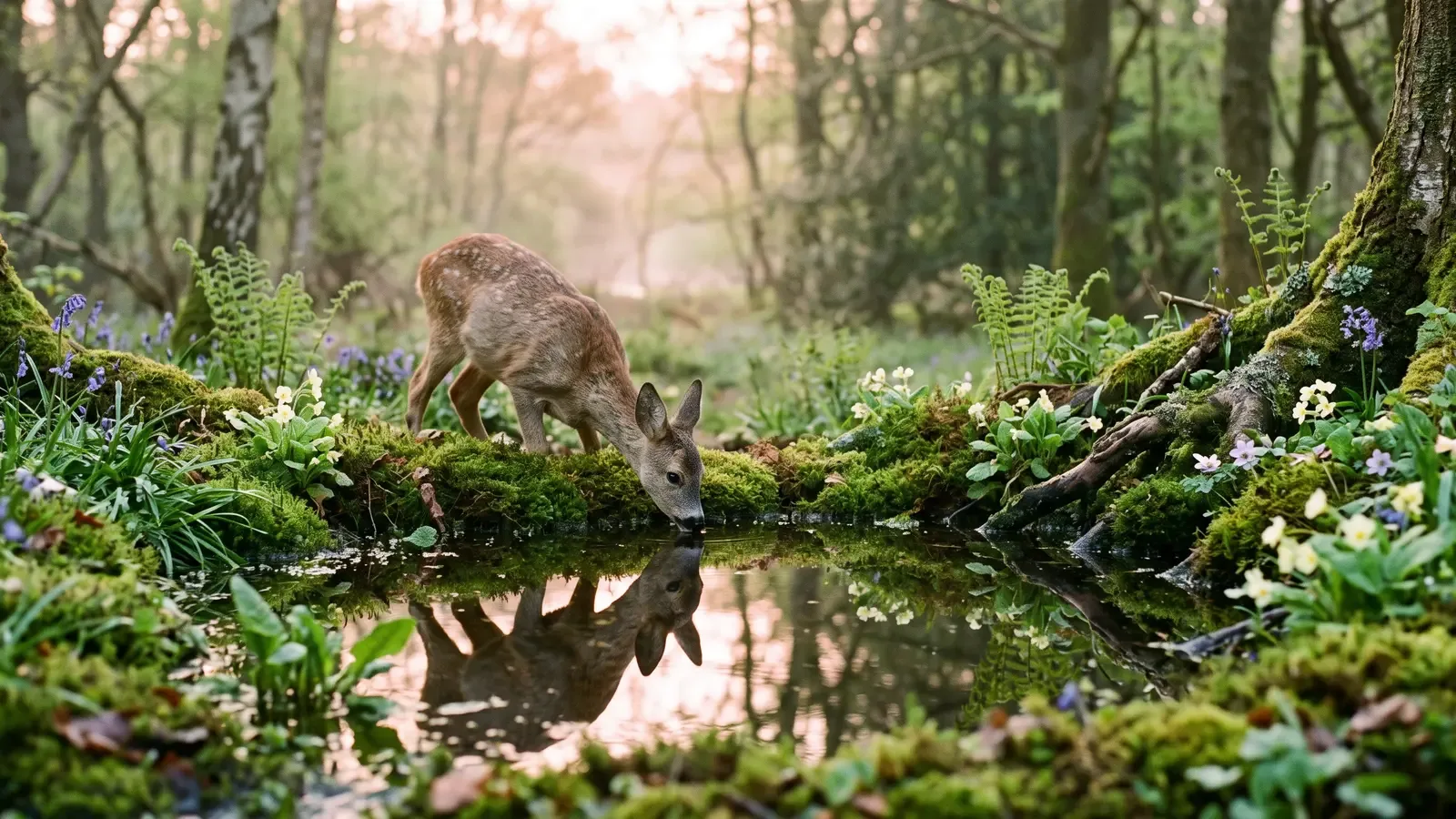
Spend even a few minutes watching a deer and you’ll see why humans associate them with awareness. Deer are built to detect change.
Their ears swivel like living radar dishes, tracking small sounds from multiple directions. Their eyes sit to the side, giving them a wide field of view. Their movements tend to look economical: a pause, a glance, a small step, another pause. When they run, it’s not usually out of drama. It’s a clean decision.
In symbolic terms, deer become an image of situational intelligence. Not the kind that requires you to argue your case, but the kind that notices the temperature in a room. The shift in a friend’s tone. The moment your body tightens before your mind catches up.
This is why deer symbolism often resonates during seasons when you’re learning to trust your perceptions without overreacting. There’s a difference between vigilance and panic. Deer don’t sprint because a leaf falls. They sprint because the pattern changes.
A useful reflection question that fits deer energy is simple: what changed, exactly?
Gentleness isn’t weakness: it’s selective force
The deer’s softness is real: careful steps, cautious curiosity, a skittish edge. But the softness is paired with capability.
A doe will place herself between danger and her fawn.
A stag’s antlers aren’t decorative. They are tools and signals, used in dominance contests and defense. Even so, much of deer life is about avoiding needless injury. The animal’s default strategy is to move away rather than escalate.
In modern symbolic language, deer can represent the mature version of gentleness: boundaries without theatrics. A refusal to become harsh just to prove you can.
You might connect with deer symbolism if you’re practicing any of these:
Letting “no” be a complete sentence.
Leaving conversations that erode you, without delivering a speech.
Choosing environments that support your nervous system.
Staying tender without staying available to harm.
Gentleness, in this frame, is not an absence of strength. It’s strength that doesn’t need to dominate.
The edge of the forest: thresholds and timing
Deer are animals of edges: forest meets field, dusk meets night, safety meets risk. They appear where cover is nearby and options are open. If you’ve ever seen a deer step out of brush and then freeze—half in shadow, half in open space—you’ve seen threshold behavior.
Symbolically, deer can speak to transitions that require timing.
Not every new chapter calls for a dramatic leap. Some call for standing at the margin long enough to sense what’s truly there. Deer remind us that pausing can be intelligent, not avoidant.
If you’re facing a decision, consider the deer-like approach:
Step to the edge.
Scan.
Take one small move.
Scan again.
This isn’t indecision. It’s a form of respect—for your instincts, for the complexity of the situation, for the fact that your first idea might not be the safest path.
For decision support that’s reflective rather than predictive, you may like this companion piece: How to Find Clarity When Facing a Big Decision.
Cultural examples: deer meanings with context
Deer symbolism isn’t one global story. Meanings change by region, history, and religious tradition. When people claim deer “always” mean one thing, it’s usually modern generalization. Below are a few examples with clear attribution—starting points for further reading, not a single blended mythology.
Celtic art and myth: the deer as otherworldly guide
In parts of Celtic tradition and later Celtic-influenced folklore, deer appear as creatures connected to the forest’s mystery and the boundary between worlds. White deer, in particular, show up as elusive, uncanny figures: not merely prey, but a kind of signal that you’re entering enchanted territory.
In that context, deer symbolism can lean toward initiation: the moment when the familiar path bends into something you can’t control with logic alone. The deer doesn’t force an outcome; it draws you onward.
Used carefully in modern reflection, this can translate into a question: what am I being invited to approach gently because it’s bigger than my certainty?
Shinto and Nara, Japan: deer as sacred messengers (specific place, specific story)
In Japan, deer hold a well-known sacred association in Nara, where they are traditionally regarded as messengers of the kami connected to Kasuga Taisha. This is not a generic “deer are sacred everywhere” claim; it’s tied to a particular religious landscape and history.
Here, deer symbolism emphasizes reverence and coexistence: humans sharing space with animals that are treated as part of a living spiritual ecology.
For a modern reader, the ethical echo is strong: awareness isn’t only personal. It’s relational. How do you move through a place—workplace, home, neighborhood—without acting like everything exists for your convenience?
Greco-Roman imagery: Artemis/Diana and the ethics of pursuit
In Greek and Roman mythology, deer are closely associated with Artemis (Diana in Roman tradition), a goddess linked with wilderness, hunting, and the boundaries of the untamed. The deer appears near her as a symbol of the wild’s dignity—something not to be owned casually.
This is a useful counterbalance to overly sweet interpretations of deer. In this mythic frame, deer symbolism can challenge you: are you pursuing what you want with respect, or with entitlement?
Gentleness here isn’t passive. It’s an ethic: take what you need with restraint, and don’t confuse desire with permission.
When deer show up repeatedly: a grounded way to interpret it
People notice deer for many ordinary reasons: seasonal movement, habitat expansion into suburbs, time of day, even just the fact that your attention is newly tuned to them.
Symbolism doesn’t require you to deny those realities. Instead, you can treat repetition as a prompt for reflection.
Try a three-step, observation-first method:
Name the moment. Where were you when you saw the deer? What was happening in your day? Not your whole life—your actual hour.
Name the bodily response. Did you soften? Startle? Feel a wave of tenderness? A jolt of fear? Deer symbolism often mirrors nervous system states.
Name the theme. What’s currently asking for gentleness and awareness at the same time? That pairing is the deer’s signature.
If your mind tends to race, it can help to explore the line between intuition and anxiety. Deer are sensitive, but they’re not trapped in fear—they’re responsive. This distinction is explored in Intuition vs. Anxiety: Understanding the Difference.
Deer in dreams: not a dictionary, but a mood and a relationship
Dream deer can be especially vivid: a doe watching you silently; a stag standing in a road; a fawn hidden in grass; a herd moving like a single organism.
Rather than assigning a fixed meaning, work with the dream like you’d work with a poem.
A calm deer that approaches may reflect a part of you that is growing more trusting, or a situation that responds better to patience than force.
A deer that bolts might reflect a boundary being crossed—something in your life that feels too fast, too loud, too invasive.
A wounded deer can be emotionally intense. In reflection (not prediction), it may suggest tenderness in a place that has been pressured: grief, burnout, or a part of you that has been “handled” too roughly.
If you want a dream-oriented approach that stays honest about uncertainty, read What Does It Mean When You Dream About an Animal?.
Shadow deer: people-pleasing, freeze responses, and false peace
Every symbol has a shadow side. Deer symbolism can become an excuse to stay small.
Sometimes what looks like gentleness is actually fear of conflict.
Sometimes “being easygoing” is a freeze response.
Sometimes “I don’t want to make a scene” translates to “I won’t protect myself.”
Working with deer symbolism doesn’t mean you must become quieter. It means you learn when quiet helps and when it harms.
Try these shadow-check prompts:
Where have I been soft when I needed to be clear?
What boundary am I hoping someone else will guess?
Am I using sensitivity to avoid making a decision?
Deer show that you can be delicate and still decisive. The shift often looks like this: you stop explaining your needs to people who benefit from misunderstanding them.
A simple deer-aligned practice: “pause, scan, step”
If deer symbolism feels relevant right now, you don’t need a big ritual. You need a repeatable pattern.
Pause for one full breath.
Scan your senses. What do you hear? What’s your jaw doing? Are your shoulders lifted? What’s the emotional weather?
Step with intention. One action that reduces noise and increases safety—send the clarifying message, take the walk, reschedule the draining commitment, ask the direct question.
This practice supports awareness without feeding rumination. It’s also compatible with secular mindfulness; you’re simply training attention.
For more small, realistic reflection practices, you may also enjoy Five Simple Reflection Exercises for Finding Personal Direction.
Deer symbolism and “spirit animal” language: choose your framing carefully
A lot of people meet deer symbolism through the phrase spirit animal. That language means different things in different communities, and in some Indigenous cultures it’s connected to specific teachings and responsibilities that aren’t public vocabulary or a casual label.
If you’re using deer as a personal symbol, you can keep it respectful by describing your experience plainly: “Deer has been meaningful for me lately,” or “I’m reflecting on deer symbolism.”
If you want a deeper overview of terminology and boundaries, see What Is a Spirit Animal? Meanings and Cultural Context and the practical guide How to Explore Animal Symbolism Without Cultural Appropriation.
A reading option for personal reflection
If you’d like a guided way to explore what deer symbolism might be highlighting in your life—your patterns, boundaries, and next best step—start with the introduction to our spirit-animal reading page: About Spirit Animal Sketch & Reading.
The takeaway: live like a deer without living in fear
Deer symbolism is an invitation to practice a rare combination: softness with sharp perception.
Let the deer remind you that awareness can be gentle.
That boundaries can be quiet.
That you can move through the world without numbing your sensitivity—and without surrendering your safety.
When you’re unsure what the deer is “saying,” return to what deer actually do: pause, listen, adjust, and choose the clean path forward.
Sources & further reading
Sources provide context for the specific topics discussed. They do not establish supernatural claims or endorse the reading experiences.