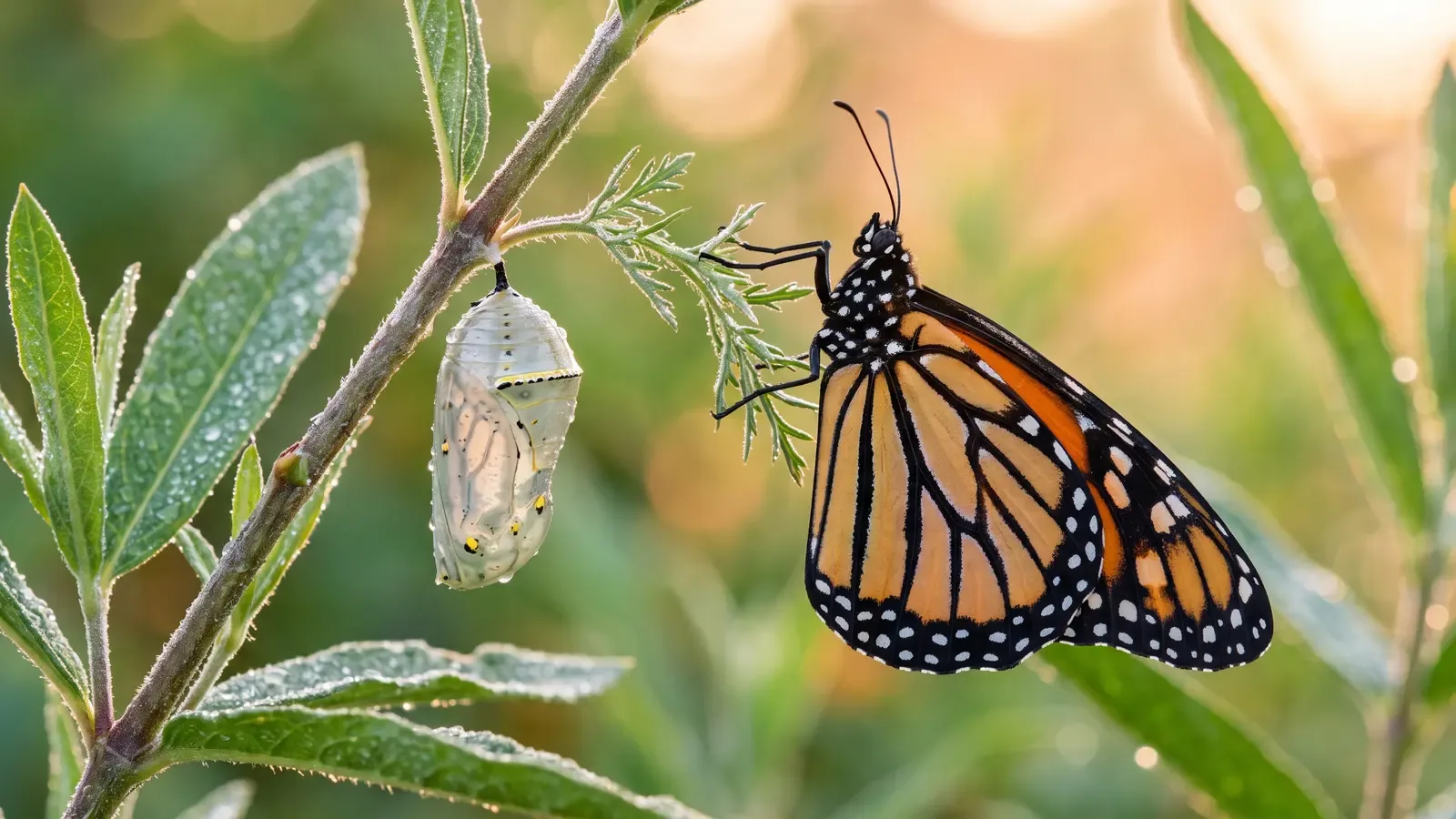
Butterflies often symbolize transformation and new beginnings because their life cycle makes change visible: egg, caterpillar, chrysalis, and adult. People also connect them with beauty, fragility, freedom, memory, or the passing of time. Those associations are interpretations, and their meaning depends on the person, artwork, or cultural context in which they appear.
Seeing a butterfly does not reliably predict a change in your life or prove that a message has been sent to you. You can still find the encounter meaningful. A symbol can help you notice what is changing without claiming to explain why it happened.
Why metamorphosis invites a story about change
The physical contrast between a caterpillar and an adult butterfly is striking. It is easy to see why writers and artists use metamorphosis as an image of becoming different. There are distinct stages, and the adult form has capacities the caterpillar did not have.
The natural process is more specific than the motivational slogan. A chrysalis is a stage in an insect’s development, not evidence that every difficult human experience produces a better life. Biology offers an image; it does not make a promise about your circumstances.
That distinction can make the symbolism more generous. You do not need to be undergoing a spectacular reinvention to appreciate a butterfly. Perhaps you are learning one skill, adjusting to a new routine, or becoming more honest about a preference.
Transformation can include continuity
A new beginning is rarely a complete erasure of what came before. You bring skills, memories, obligations, and relationships into a different situation. The image of transformation can help you ask what you want to carry forward as well as what you want to change.
Imagine returning to study after years in paid work. The setting is new, but organizing tasks, communicating, and asking questions may already be familiar strengths. Thinking only about becoming “a new person” can hide resources you already have.
Try writing two lists: “What I am learning” and “What I am bringing with me.” You may find that a transition feels less like starting from nothing when both lists are visible.
The chrysalis as a metaphor for an unfinished stage
People sometimes use the chrysalis to represent quiet, uncertainty, or development that is not yet visible. It can be a comforting image when your progress is difficult to explain to someone else.
Use it with care. A period of waiting does not always need to be interpreted as hidden spiritual work, and prolonged distress should not be dismissed as a necessary stage before a breakthrough. Sometimes what you need is information, rest, practical assistance, or professional care.
A helpful question is “What supports this stage?” rather than “When will I emerge as someone better?” The answer might be a clearer schedule, fewer comparisons, or permission to try an approach that is less ambitious but more sustainable.
Beginnings, endings, and the feeling in between
Butterfly imagery is often cheerful, yet change can contain grief as well as hope. A desired move may involve missing familiar places. A positive career change may mean losing everyday contact with people you like. Becoming more independent can feel exciting and lonely at once.
You do not need to turn those mixed feelings into a sign that the change is wrong. Nor does a hopeful symbol require you to describe every ending positively. It can hold a question while you work out what the experience means.
If you use a butterfly image in a journal, try putting one sentence beneath each wing: “What I welcome” and “What I miss.” Giving both experiences space can produce a more honest reflection than insisting that transformation should feel joyful throughout.
Does a butterfly’s color have a special meaning?
Online lists often assign meanings to white, yellow, blue, or black butterflies. Those lists are not a universal code. Color symbolism varies across sources and communities, and the color of an actual butterfly also belongs to its species and biology.
You can begin with your own association. Yellow might remind you of a particular garden; white might recall a photograph; blue might simply be a color you enjoy. A personal connection does not need to be advertised as an ancient meaning shared by everyone.
Avoid frightening interpretations that describe an insect’s color as a warning of illness, death, or misfortune. An encounter with wildlife does not establish such an outcome. Aura color symbolism explores a similar distinction between personal meaning and unsupported certainty.
Cultural context changes the interpretation
Animal symbols appear in many traditions, but that does not mean they share one meaning everywhere. A museum object, a poem, a religious practice, and a contemporary commercial quiz need to be understood in their own contexts.
If you want to learn about a named community’s symbolism, begin with sources produced by or in collaboration with that community. The National Museum of the American Indian’s Native Knowledge 360° resources emphasize the diversity and continuing presence of Native peoples. That is a better starting point than a chart claiming one meaning for all Indigenous cultures.
The commercial phrase “spirit animal” also deserves care. You can explore an animal image as a personal artistic symbol without claiming access to a community’s sacred relationships or practices. “Animal symbolism” or “an animal I connect with” may describe your own interest more accurately.
A butterfly reflection in four ordinary steps
First, describe the change without spiritual interpretation: “I am moving,” “My responsibilities are different,” or “I want to make time for art.” A plain description gives the image somewhere useful to land.
Second, choose one quality the butterfly suggests to you. It might be patience, movement, delicacy, or openness. Third, connect that quality with a practical need. Patience could mean allowing time to learn a route in a new neighborhood; movement could mean taking one small action you have postponed.
Finally, decide how you will know whether the action helped. You might feel less rushed, have one useful conversation, or complete a task. Those observations tell you about your choices. They do not prove that the butterfly directed them.
Enjoy the encounter without turning it into a task
Not every sighting needs a message. Watching an insect visit flowers can be enjoyable on its own. You are allowed to notice beauty without researching what the universe supposedly expects you to do next.
If you photograph wildlife, observe without touching or disturbing it. If you use the image in art, look closely at shape, texture, and movement. Attention to an actual living creature can be more interesting than treating it only as a symbol for yourself.
A useful journal note might be as simple as “I stopped long enough to notice this.” That is already an account of a real experience, even if it never becomes a turning point.
Where a personalized animal experience fits
A personalized illustration can be another way to explore qualities you appreciate. The Spirit Animal Sketch information page explains that the provider’s starting questionnaire is free to begin and that finished artwork or detailed readings may cost extra. Its examples are illustrative, and a portrait does not establish a supernatural identity.
You do not need a quiz to authorize your interest in butterflies, wolves, or any other animal. If you enjoy the artistic process, review its information and photo requests before continuing. Keep the distinction between a creative interpretation and a cultural or factual claim.
A butterfly can stand for change, but it can also remind you to look more carefully at the stage you are in. The next beginning may be modest. It can still deserve your attention.
Sources & further reading
Sources provide context for the specific topics discussed. They do not establish supernatural claims or endorse the reading experiences.