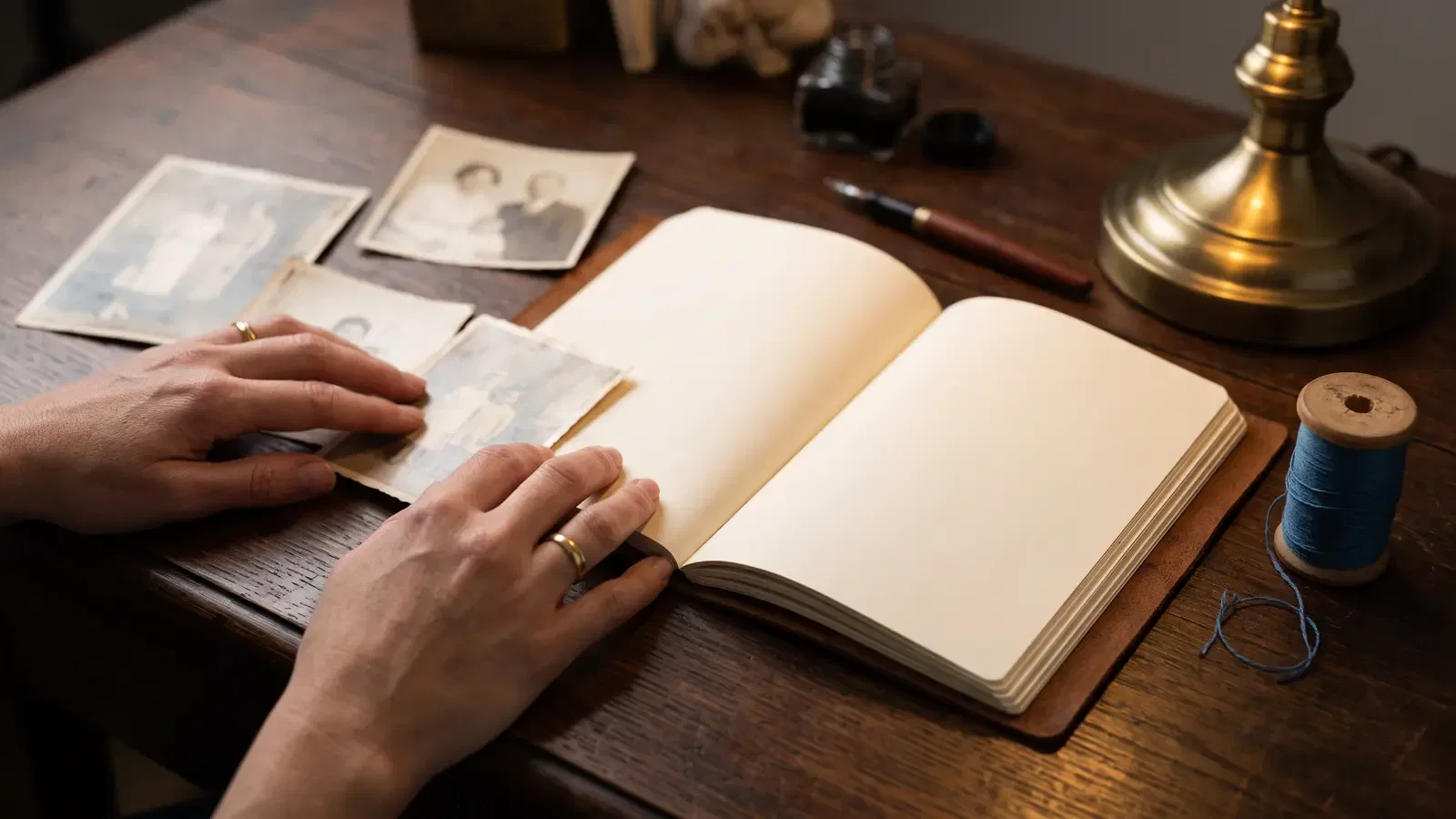
Exploring your personal soul story through reflection means creating a compassionate, reality-based narrative about what your life has taught you so far, what you seem to be here to practice, and what you’re ready to release next. Soul story journaling isn’t recovered-memory practice and it isn’t meant to “prove” past lives or guarantee destiny. It’s a symbolic way to listen for themes: the roles you repeat, the values you defend, the fears you negotiate, the moments you become more yourself.
What follows is a creative reflection worksheet you can return to whenever you’re at a crossroads, feeling strangely stirred by a person or place, or simply wanting language for your inner life.
What “soul story journaling” is and isn’t
In modern spiritual circles, “soul story” usually means the felt arc beneath the facts: the emotional truth, the meaning you make, and the lessons you keep meeting in different costumes. In psychological terms, it overlaps with narrative identity: the way we organize memories into a story that explains who we are and what matters to us.
It is not a method for excavating hidden trauma, retrieving suppressed memories, or forcing an explanation for every pain you’ve lived through. If difficult memories surface while journaling, your job is not to interrogate them until they become a tidy plot twist. Your job is to take care of your nervous system and choose grounding.
Use this practice as a lantern, not a shovel.
If you’re also curious about how people interpret “meaningful coincidences” without treating them as proof, you may like Meaningful Coincidences: How People Interpret Synchronicity.
Before you write: set the container
A soul story worksheet works best when it feels safe, bounded, and kind. Five minutes of setup can change the entire tone of what you discover.
Choose a time limit. Try 20 minutes for the first session. Ending on time teaches your mind that introspection doesn’t have to become a spiral.
Choose a stance. The stance is: curious witness, not harsh judge. Imagine you’re writing about someone you love, with clear eyes and warm boundaries.
Choose a grounding cue. A cup of tea, a specific playlist, feet on the floor, or a hand on your heart. Repeat the same cue each session so your body learns, this is reflection time, and we are safe.
If you struggle to tell the difference between a true inner nudge and a fear-loop, keep this nearby: Intuition vs. Anxiety: Understanding the Difference.
The Soul Story Reflection Worksheet
You can do this in one sitting or across a week. Write quickly. Don’t over-polish. Your first draft is allowed to be messy and honest.
1) The three-scene memory scan
Pick three scenes from your life. Not “the three biggest things that ever happened,” but three moments with emotional electricity.
Scene A: a moment you felt seen.
Scene B: a moment you felt lost.
Scene C: a moment you surprised yourself.
For each scene, answer:
Where was I?
Who was there?
What did I believe about myself in that moment?
What did I need but didn’t know how to ask for?
What did I do next?
Then write one line beneath all three scenes:
The part of me that shows up in all three scenes is…
This line is often the first thread of your soul story. It might be “the one who tries to earn love,” “the one who keeps the peace,” “the one who leaves before being left,” or “the one who can’t ignore what’s unfair.” Don’t fix it yet. Just name it.
2) The recurring roles inventory
Most of us repeat roles long before we repeat lessons. Roles are the characters you keep getting cast as.
Complete these prompts:
In groups, I often become the…
In my family, I learned to be the…
In romance or close friendship, I tend to become the…
At work or in service, I become the…
Now circle one role that feels heavy.
Write:
What does this role protect me from?
What does it cost me?
What would be different if I retired it by 10 percent?
This is where soul story journaling stays grounded: you’re not diagnosing cosmic fate; you’re noticing patterns and gently renegotiating them.
If you want a companion piece that stays firmly behavior-based (not label-based), see Recurring Relationship Patterns and Self-Reflection.
3) The “bright thread” exercise
Now look for the opposite of your pain story: the bright thread that has quietly persisted.
Write five sentences that begin with:
Even when things were hard, I kept…
Even when I felt alone, I still…
Even when I was afraid, I tried…
Even when I didn’t believe in myself, I…
Even when I failed, I learned…
Then ask:
What quality do these sentences reveal?
That quality is often a truer “soul signature” than any dramatic narrative. It might be endurance, tenderness, honesty, creativity, protectiveness, or devotion to learning.
4) The soul values map
A soul story becomes useful when it points to values you can live on purpose.
Choose three values you suspect your life keeps requesting. Not aspirational values you think you should have, but values your experiences keep circling.
Examples: honesty, belonging, freedom, stability, courage, devotion, play, beauty, integrity, sovereignty, compassion, mastery.
For each value, write:
How do I recognize this value in my body when it’s present?
How do I recognize it when it’s missing?
What is one boundary that protects this value?
What is one habit that nourishes this value?
If you want extra support clarifying values in practical language, you can also read How to Reconnect With Your Personal Values.
5) The symbol dictionary (without forcing meaning)
Soul story journaling can include symbols, but the key is to let symbols be suggestive, not definitive.
Make a list of 10 symbols that keep appearing in your inner or outer life. Use any category:
A recurring dream setting
A repeated animal, song lyric, or phrase
A color you keep choosing
A number you notice
A place you feel pulled toward
For each symbol, write three columns in your journal (not a table, just three short sections):
My associations: What does it mean to me personally? What memories does it touch?
Cultural or spiritual meanings I’ve heard: What are common symbolic interpretations (without treating them as fact)?
My grounded translation: What action, boundary, or conversation might this symbol be nudging me toward?
Example: If you keep dreaming of locked doors, you might associate them with being excluded. You may have heard “doors” symbolize opportunity. Your grounded translation could be: I need to ask directly for access, training, or clarity instead of waiting to be invited.
6) The “two truths” paragraph
This is the heart of the worksheet. Write one paragraph that holds two truths at once: your tenderness and your agency.
Use this template:
It makes sense that I ______, because ______.
And I’m ready to practice ______, so that ______.
Example:
It makes sense that I kept overexplaining, because I learned love could be withdrawn without warning. And I’m ready to practice simple, calm honesty, so that I can be understood without abandoning myself.
Notice what this does: it validates the past without enshrining it as fate.
7) The chapter you’re in now
Soul stories become clearest when you name your current chapter like a book.
Title your chapter with a phrase that feels emotionally accurate, such as:
Learning to Trust What I Know
The Year of Cleaner Yeses
Returning to My Own Timing
Building a Life That Can Hold Me
Then answer:
What am I being asked to learn in this chapter?
What am I being asked to stop?
What support would make this chapter more livable?
What would “progress” look like in one small, concrete way this month?
If you want a few short exercises that pair well with this section, see Five Simple Reflection Exercises for Finding Personal Direction.
8) A gentle numerology add-on (optional)
If numerology is part of your reflective vocabulary, you can use it here as symbolism, not a verdict.
Many people start with Life Path and related numbers as a way to generate journaling prompts. If you’re new to it, begin with What Is Your Life Path Number? Calculate It Using Your Birthday and then explore interpretations in Life Path Numbers 1–9: What Each Number Traditionally Represents.
Then try this reflective translation:
If this number’s themes were a “training ground,” what might I be practicing?
Where do I overdo the shadow side of this theme?
What does balance look like for me, specifically?
Keep the emphasis on lived reality. If an interpretation makes you feel boxed in, treat it as the wrong language for today.
How to use your soul story without turning it into a cage
A good soul story should make you more flexible, not more fixed.
After you complete the worksheet, write a short “editor’s note” to yourself:
What parts of this story feel undeniably true?
What parts might be a protective myth I’m ready to update?
What am I curious about now?
Then choose one small experiment for the next seven days. Not a grand vow. An experiment.
Examples:
If your story theme is people-pleasing, your experiment could be: pause before answering requests and say, “Let me check my schedule.”
If your story theme is hiding your creative work, your experiment could be: share one draft with one trusted person.
If your story theme is self-abandonment in conflict, your experiment could be: write your point in three sentences before the conversation.
Your soul story becomes real when it changes what you do, not when it becomes an intricate explanation.
When the practice gets emotionally intense
Sometimes reflection hits a live wire. If you notice racing thoughts, numbness, or a compulsion to write for hours, shift from meaning-making to regulation.
Close the notebook.
Name five things you can see.
Drink water.
Text a friend.
Take a walk.
You can return later and rewrite your “two truths” paragraph with extra gentleness. Soul story journaling is allowed to be slow.
If you’re in a season of transition and everything feels tender, you may also appreciate Why Do We Feel Stuck During Life Transitions?.
A place to store what you discover
Many people find it helpful to keep their soul story pages in one dedicated space, like an ongoing “archive” of themes, symbols, and chapter titles. Over time, you can flip back and see what truly repeats and what naturally resolves.
If you’d like a guided way to organize those reflections, you can start with the introduction to the Soul Archive reading here: [About Soul Archive Reading](/free-readings/soul-archive/). Think of it as a library card for your inner life: a way to gather what you’ve already lived into language you can use.
The point of the worksheet
You’re not writing a myth to escape your life. You’re writing a story that helps you inhabit it.
When soul story journaling works, it doesn’t hand you certainty. It gives you coherence: a sense of what you care about, what you’re learning, and what kind of person you want to be when the next chapter asks more of you.
Return to the worksheet anytime you feel the old roles tightening, anytime a symbol keeps tapping your shoulder, or anytime you realize you’ve changed and your story needs to catch up.
Sources & further reading
Sources provide context for the specific topics discussed. They do not establish supernatural claims or endorse the reading experiences.