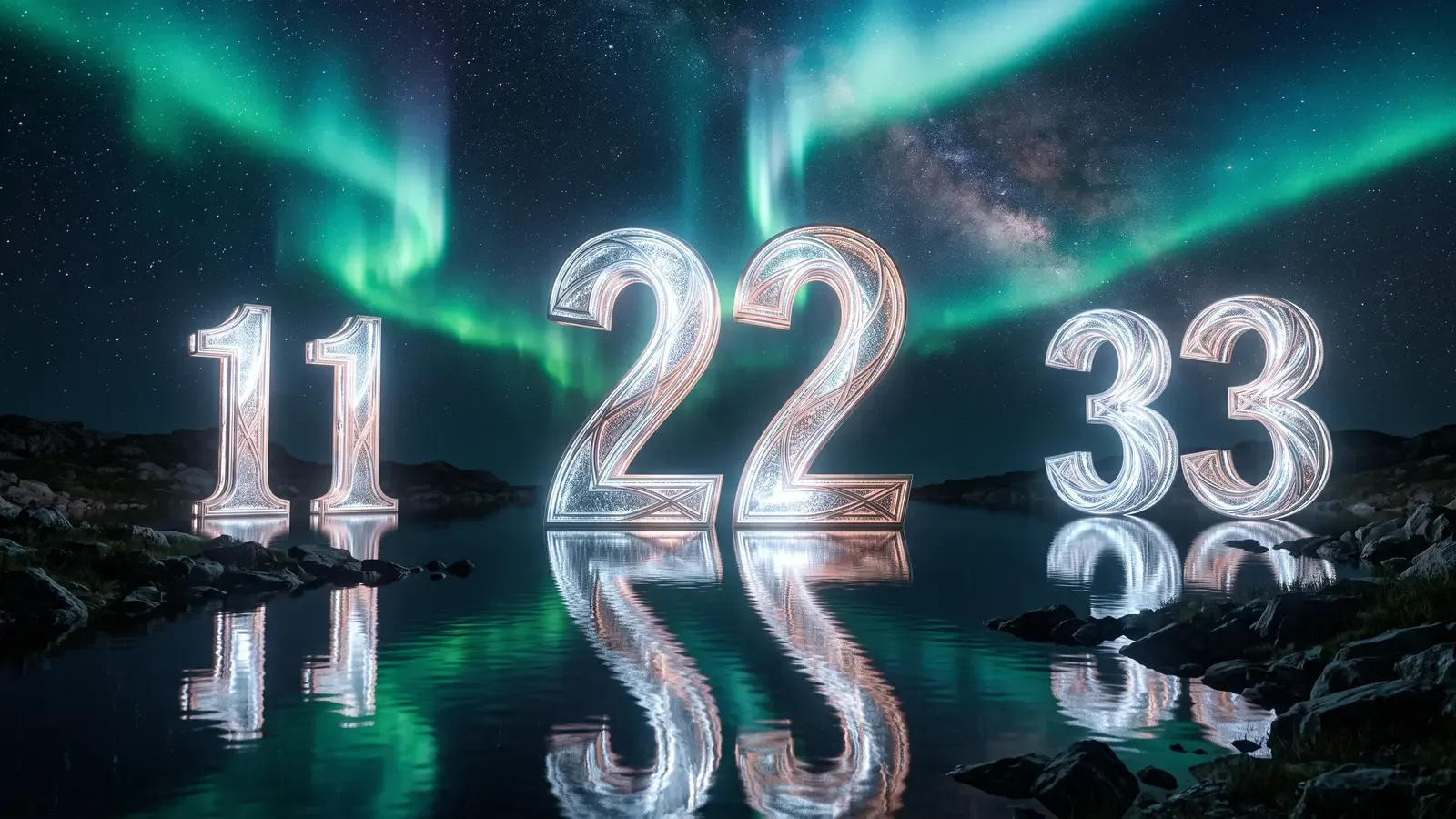
Master numbers 11, 22, and 33 are the three double-digit numbers most commonly treated as “special cases” in modern numerology: you don’t automatically reduce them to a single digit the way you would 12 (1+2=3) or 29 (2+9=11, then possibly 1+1=2). Instead, many numerology traditions preserve 11, 22, and 33 as intact numbers because they’re thought to describe a higher-voltage version of their root numbers 2, 4, and 6.
That’s the quick explanation. The useful one is this: master numbers are less like “better” numbers and more like high-ceiling archetypes. They can feel inspiring, pressurized, or oddly inconsistent depending on your life stage, your support system, and how you handle responsibility. If a master number shows up in your Life Path, Expression/Destiny, or other core numerology placements, you may recognize a push-pull between big vision and the ordinary human work of living.
What makes a number a “master number” in numerology?
Numerology isn’t a single standardized system; it’s a family of symbolic practices. Within modern Western numerology (especially approaches influenced by 20th-century popular numerology), 11, 22, and 33 are commonly called master numbers.
They’re “master” in the sense of mastery themes: heightened sensitivity, heightened responsibility, and a sense that your choices echo outward. The idea isn’t that you’re destined to be famous or spiritually perfect. It’s that the symbolism points toward learning to hold more intensity without burning out or scattering.
A practical way to remember the trio is by their roots:
11 is often framed as an amplified 2: intuition, connection, diplomacy, and emotional attunement, with an added current of inspiration.
22 is often framed as an amplified 4: structure, discipline, building, and real-world results, with an added current of vision.
33 is often framed as an amplified 6: care, responsibility, teaching, and service, with an added current of compassion.
In many readings, you’ll also hear the phrase “master number with a root.” For example, “11/2” acknowledges both the master vibration (11) and the grounded baseline (2). This helps keep interpretations human. When the master feels too intense to live cleanly, you may fall back to the root pattern.
Where master numbers show up (and why it matters)
You can run into 11, 22, or 33 in several places, but they’re most frequently discussed in relation to your Life Path number.
If you’re new to that concept, start with the foundational overview: What Is a Life Path Number? A Beginner’s Guide. If you want the full step-by-step calculation tutorial (with convention notes), use What Is Your Life Path Number? Calculate It Using Your Birthday.
In master-number tradition, you typically preserve 11, 22, and 33 at each step of reduction. That means you don’t crush an 11 down to 2 unless your system explicitly says to reduce everything.
A quick example of what “master-preserving” looks like as a method, without turning this into a full calculation lesson:
You reduce month, day, and year separately, keeping 11/22/33 intact if they appear.
Then you add those reduced values and reduce again, preserving master numbers.
This matters because if you only reduce everything immediately, you’ll miss the symbolic storyline many readers associate with master numbers: the friction between a big calling and the practical self you have to build to meet it.
Master number 11: the intuitive amplifier
In modern numerology, 11 is often described as the most “psychic” master number. Not because it guarantees supernatural experiences, but because its symbolic toolkit is about perception: sensitivity, pattern-recognition, intuition, and inspiration.
If 2 is the number of partnership and attunement, 11 is often framed as attunement turned up so high it becomes a signal you have to learn to manage.
Common themes associated with 11
Heightened sensitivity to people and environments. You may pick up on tone shifts, subtext, or unspoken tension quickly.
A strong relationship with meaning. 11 energy often wants life to make sense, not just function.
A “channel” feeling with ideas. Inspiration can arrive in surges, followed by periods of doubt or depletion.
A pull toward bridging roles: translator, mediator, creative interpreter, spiritual seeker, communicator.
The growth edge of 11
The shadow side of 11 isn’t “badness,” it’s overload.
An 11 pattern can become anxious scanning: treating every coincidence as a message, every decision as fate, every mood as a sign. If you relate to that, you may appreciate a grounded reality check on meaning-making in Meaningful Coincidences: How People Interpret Synchronicity.
Another common 11 pitfall is mistaking intensity for accuracy. Intuition can be wise, but it can also be colored by stress, lack of sleep, or old fear. A helpful companion topic is Intuition vs. Anxiety: Understanding the Difference.
How to work with 11 in everyday life
Give your sensitivity a container. The container might be a creative practice, a consistent routine, therapy, coaching, meditation, prayer, or even just a non-negotiable bedtime.
Translate inspiration into small steps. 11 can live in the clouds; it needs a ladder.
Practice “signal hygiene.” If you’re prone to reading omens everywhere, try a simple rule: write the sign down, then wait 24 hours before acting on it. You’ll still honor your inner life without letting it run your calendar.
Master number 22: the builder archetype
22 is often called the “master builder” in popular numerology. It’s the big-vision number that still cares about materials, plans, budgets, and timelines. Where 11 can be pure lightning, 22 is lightning routed into a power grid.
If 4 is structure and stability, 22 is structure in service of a bigger mission.
Common themes associated with 22
Capacity for long-term projects. Not just dreaming, but organizing.
A relationship with responsibility and impact. 22 tends to ask, “What am I building that outlives my mood?”
Systems thinking. Seeing how the parts affect the whole.
Leadership that’s practical: operations, frameworks, scalable solutions.
This is also where we can clarify a trending confusion: people sometimes lump “power, money, authority” into master-number talk, but that’s more traditionally associated with the symbolism of 8 (ambition, leadership, balance). If you want that thread, keep it separate and go deep with Life Path Number 8: Ambition, Leadership, and Balance.
The growth edge of 22
Pressure. A 22 pattern can feel like you’re always behind on a destiny-sized project.
Control. Because 22 sees how easily things fall apart, it may over-manage or struggle to delegate.
Collapse into the root. When 22 gets overwhelmed, it can revert to the lower expression of 4: rigidity, fear of change, all-or-nothing thinking.
How to work with 22 in everyday life
Build in phases. Think prototype, then refine, then expand. 22 thrives when it respects sequencing.
Let values, not adrenaline, run the project. If you need a values reset, How to Reconnect With Your Personal Values pairs well with 22 work.
Choose one metric of “real-world progress.” Not ten. One. 22 can drown in dashboards.
Master number 33: the teacher and caretaker archetype
33 is often described as the “master teacher” in modern numerology. It’s tied to service, healing symbolism, and compassionate leadership. Importantly, this doesn’t mean 33 people are saints, or that you owe the world endless emotional labor.
If 6 is responsibility and care, 33 is care expanded into a calling: teaching, guiding, uplifting, or creating environments where others can grow.
Common themes associated with 33
A strong urge to help. Often paired with empathy and moral sensitivity.
Teaching energy: mentoring, coaching, parenting, training, advocating.
A drive to model what you believe. 33 tends to ask for integrity between values and behavior.
Creative service. Many people experience 33 through art, design, hospitality, community-building, or spiritual support.
The growth edge of 33
Over-responsibility. Feeling accountable for everyone’s feelings or outcomes.
Resentment and depletion. Giving becomes obligation; compassion becomes burnout.
Martyr narratives. Not always dramatic, sometimes subtle: “If I rest, I’m selfish.” “If I’m not useful, I’m nothing.”
33 often benefits from learning that boundaries are not a lack of love; they’re a way to keep love sustainable.
How to work with 33 in everyday life
Define your role clearly. Are you supporting, teaching, or rescuing? Only the first two are healthy long-term.
Practice compassionate limits. Pick one place you won’t overgive: time, money, emotional labor, or availability.
Teach what you’re practicing, not what you’ve perfected. This keeps 33 human and credible.
Do master numbers mean you’re “more advanced” than others?
In most grounded numerology practice, no. Master numbers aren’t a trophy. They’re a symbol of intensity.
An 11 Life Path isn’t automatically “better” than a 2 Life Path; it may simply feel more amplified. A 22 isn’t guaranteed success; it may simply face more responsibility themes. A 33 isn’t guaranteed spiritual wisdom; it may wrestle more directly with care, boundaries, and service.
And you don’t need a master number to live a meaningful life. The single digits 1–9 carry complete symbolic toolkits on their own; master numbers are one interpretive lens, not the whole story. If you want the broader reference for the nine Life Path archetypes, see Life Path Numbers 1–9: What Each Number Traditionally Represents.
Why you might relate to a master number even if it isn’t your Life Path
People often “meet” 11, 22, or 33 through repeating-number experiences: 11:11 on the clock, 222 on receipts, 333 on license plates. In modern spiritual culture, these are sometimes called angel numbers. A grounded way to hold that is as attention and pattern: numbers can become symbols your mind uses to flag a theme.
If you’re exploring repeating numbers, keep that practice distinct from full numerology charts. You can start here: Why Do You Keep Seeing 111, 222, 333, 444 and 555?.
You may also have master numbers in other numerology placements, depending on the system: Expression/Destiny (from your full birth name), Soul Urge, Personality, maturity numbers, or personal cycles. Those placements can make a master number feel present even if your Life Path is a single digit.
A grounded way to apply master number symbolism (without making it fatalistic)
Master numbers are most useful when you treat them as reflection prompts rather than predictions.
If 11 is active for you, ask: Where am I taking in too much signal? What helps me return to my own center?
If 22 is active for you, ask: What structure would make my vision easier to live? What’s the next small build step?
If 33 is active for you, ask: What kind of care is sustainable for me? Where do I need clearer boundaries to keep my heart open?
When you work this way, master numbers stop being pressure and become language.
If you want to explore your numbers more deeply
If you’re curious how master numbers might show up across multiple parts of your numerology code, you can explore our Hidden Destiny Code introduction here: About Hidden Destiny Code Reading. The introduction is free where offered, and it’s designed to help you learn the framework before you decide how far you want to go.
Master numbers 11, 22, and 33 can be inspiring symbols, but they’re at their best when you bring them down to earth: sensitivity with boundaries, vision with steps, compassion with sustainability.
Sources & further reading
Sources provide context for the specific topics discussed. They do not establish supernatural claims or endorse the reading experiences.